
Helical vs spur gears:
a buyer's selection checklist
Choose a candidate gear type, then check the load, shaft arrangement and supporting hardware before requesting a quote.
Published 28 October 2026 · By JOYLINKTECH · Based on the manufacturer references below.
Spur gears have straight teeth parallel to the shaft axis. Helical gears have angled teeth that engage progressively, generally producing smoother, quieter operation. A parallel-axis, single-helical pair also produces axial thrust, which its supporting arrangement must accommodate. These differences help shortlist a design; the selected gear or gearbox still needs ratings for the application. [1, 2]
This guide compares external spur gearing with parallel-axis, single-helical gearing. Crossed-helical, double-helical and complete planetary arrangements need their own checks. A change in tooth form is not a drop-in replacement specification.
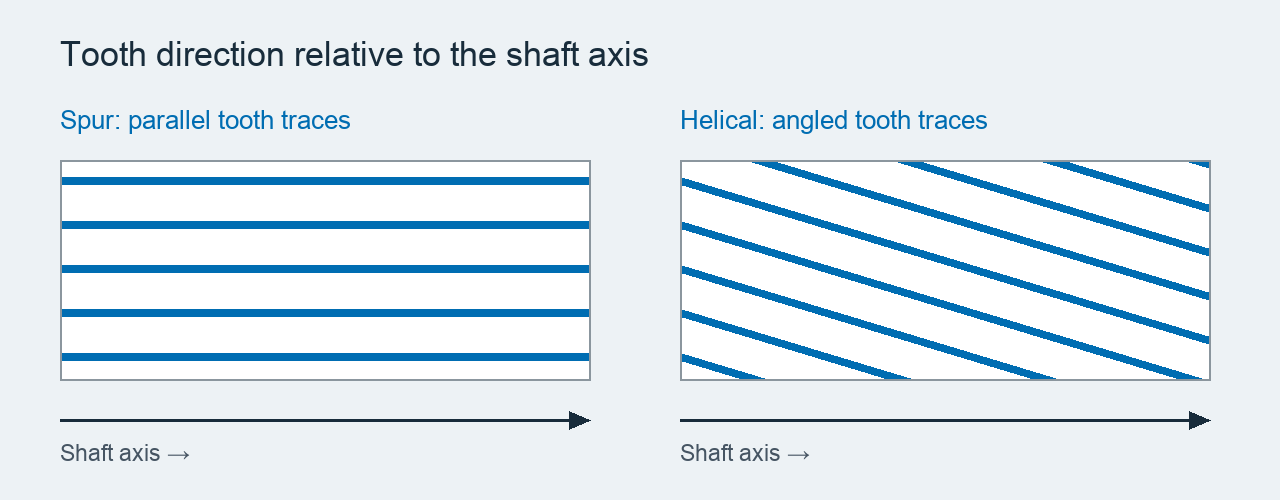
What changes between helical and spur gears?
| Feature | Spur gears | Single-helical gears | Buyer check |
|---|---|---|---|
| Tooth direction | Straight, parallel to the axis | Angled to the axis | Specify the gear geometry and matching pair. |
| Engagement and noise | Can become noisier as speed increases | More gradual engagement; generally quieter | Ask for noise evidence at the required operating conditions. |
| Axial thrust from the mesh | No axial thrust from the ideal spur mesh | Axial thrust must be accommodated | Confirm the bearing and housing arrangement. |
| Manufacture | Simpler geometry; generally economical | More complex geometry | Compare quotations against the same specification. |
Gear Motions describes the trade-off as smoother engagement versus the added axial thrust of helical gears. KHK states that helical gears “create thrust force in the axial direction.” This is a reason to check the assembly, even when the requested part is a single gear. [1, 2]
Use model-specific values for efficiency, torque capacity and noise. WM Berg's comparison assumes equal width, size and material, with suitable alignment and lubrication. A percentage or speed limit quoted without those conditions is a poor basis for comparing two supplier offers. [3]
Six checks before selecting a candidate
Work through these checks in order. “Continue” means the request is ready for the next check. “Hold” means obtain the missing information before treating the candidate as suitable. These are procurement checkpoints, not a calculation or approval of the mechanical design.
Define the item and shaft arrangement
Input: State whether you need individual gears, a matched pair, or a complete reducer. Attach a drawing showing shaft positions, rotation directions and interfaces.
Decision: Continue when the supplier identifies the same item and shaft layout in its proposed drawing. Hold if the proposal changes the layout or leaves an interface undefined. A right-angle drive needs a separately specified arrangement.
Evidence to request: A dimensioned proposal drawing and the exact ordering code. For a replacement, include the existing code or drawing revision. KHK distinguishes gear types by shaft arrangement and lists geometry as a selection input. [1]
State the operating load and speed
Input: Give input and output speeds, required continuous output torque, peak torque and how long and how often the peaks occur. Record starts, reversals and operating hours.
Decision: Continue when the supplier maps those conditions to the candidate's published ratings and states its selection assumptions. Hold if the response gives only a motor power or gear-type name without checking your load profile.
Evidence to request: The candidate datasheet and a written selection response referencing your input values. KHK lists allowable torque and efficiency among the parameters to consider. [1]
Resolve the axial load path
Input: Identify the existing bearing arrangement and whether the supplier supplies the bearings and housing. Flag missing bearing information.
Decision: For a single-helical candidate, continue only when the responsible designer or supplier confirms how mesh thrust is supported. Hold a spur-to-helical replacement if that confirmation is missing.
Evidence to request: The assembly drawing and a written confirmation of the axial support arrangement. For a complete reducer, also request its permitted external shaft loads; those are separate from the internal gear mesh. KHK and Gear Motions both identify axial thrust as a helical-gear consideration. [1, 2]
Turn “quiet” into an acceptance condition
Input: Record the machine's noise requirement, measurement location, speed and load. If there is no defined limit, mark noise as an unresolved requirement.
Decision: Continue when the proposed test or available evidence uses conditions accepted by the buyer. Hold a noise-based choice if the only support is the word “quiet” or an unexplained decibel reduction.
Evidence to request: The supplier's test conditions or an agreed acceptance-test proposal. The sources describe a general noise advantage for helical gearing; they do not establish a noise result for your machine. [2, 3]
Match the installation and rating conditions
Input: Attach the available envelope, mounting details, ambient conditions and lubrication requirements. For individual gears, include the specified tooth geometry, material and any required treatment or accuracy grade.
Decision: Continue when the supplier confirms the supplied configuration and the conditions attached to its ratings. Hold if the quotation silently changes a material, mounting detail or lubrication assumption.
Evidence to request: The dimensional drawing, applicable material and gear data, and the installation/lubrication instructions for the proposed product. KHK lists these geometry and manufacturing factors; WM Berg makes alignment and lubrication conditions explicit in its comparison. [1, 3]
Compare the same scope of supply
Input: Send each supplier the same worksheet revision, quantity, destination and required delivery date. List which items are included: gears, bearings, housing, motor adapter or complete assembly.
Decision: Continue to commercial comparison when each offer identifies its part code, inclusions and deviations. Hold a “cheaper” conclusion when one offer covers a bare gear and another covers a reducer, or when a technical deviation remains open.
Evidence to request: An itemized quote, proposed drawings and a list of deviations against your request. Record unanswered points alongside the price.
A worksheet for comparing supplier responses
Copy the fields below, or download the text file and fill it in. For each unresolved technical field, ask the supplier to respond with the proposed value and the document that supports it. Keep the same revision when requesting competing offers.
Download gear selection worksheet ↓
Project / request revision:
Item: individual gear / matched pair / complete reducer
Existing part code and drawing revision:
Shaft arrangement and rotation directions:
Input speed / required output speed (rpm):
Continuous / peak output torque (N·m):
Peak duration and frequency / starts / reversals:
Operating hours and duty cycle:
Axial support arrangement / responsible designer:
Noise requirement and measurement conditions:
Envelope / mounting / motor or shaft interfaces:
Ambient conditions / lubrication requirements:
Gear geometry / material / treatment / accuracy, if specified:
Included components:
Quantity / destination / requested delivery date:
Supplier response: proposed code, drawing, ratings and deviations
Open question | owner | evidence required | resolved date:
For reducer sourcing, the JOYLINKTECH gear reducer page lists the initial application inputs. The motion and transmission section places those inputs in the wider drive assembly. When your request is ready, prepare an inquiry or email customer@joylinkrobot.com with the worksheet and drawings. Product suitability and commercial terms require confirmation for the proposed configuration.
Manufacturer references and scope
Technical descriptions were checked against these manufacturer publications on 28 October 2026. The six-step workflow and worksheet are JOYLINKTECH's compilation for preparing a sourcing request. This article reports no physical testing of gears or reducers.
- KHK: Types of Gears. Gear definitions, shaft arrangements, helical thrust, matching geometry and selection parameters.
- Gear Motions: Helical Gears vs. Spur Gears, published 15 February 2017. Engagement, manufacture and axial-thrust trade-offs.
- WM Berg: Comparison: Spur Gears vs. Helical Gears, published 25 June 2024. Performance factors and the assumptions used for its comparison.